Monday, November 16, 2009

Great American Smokeout; Fast Facts ~

It's time to kick off the Great American Smokeout week ~
The American Cancer Society first sponsored this event in 1977. On the third Thursday in November of each year, the Great American Smokeout encourages people to stop smoking, even if it is for just one day.

Fast Facts:

*Held on the third Thursday of November each year.
* 2009 Great American Smokeout: Thursday, November 19th
* Challenge: Quit smoking for 24 hours
* The Great American Smokeout began in Massachusetts in 1971 when a high school guidance counselor asked people to give up cigarettes for a day.
* The idea caught on and the first "D-Day" or "Don't Smoke Day" was held in Minnesota in 1976. * The American Cancer Society began sponsoring the event in 1977.
* By the early 1980s, nearly 16.5 million people participated in the Great American Smokeout.
* Smokers who smoke one pack a day spend about $1,600 a year on cigarettes.
* Use of tobacco products contributed to over 438,000 premature deaths in the U.S. between 1997 and 2001.
* 87 percent of lung cancer deaths are associated with smoking.
* At least 16 types of cancer are associated with smoking.

Friday, November 13, 2009

Great American Smoke Out, 2009 ~

November 19th 2009;
Less than five days from now --
it's almost time and it's the perfect time to set your date and prepare to quit for good!

In an effort to help anyone who desires to quit now I want to encourage you to read and follow my previous post, ~ 11 Steps ~ . This will give you many of the tools you need.

If you want to strip it down to the bare bones there was a post in August, Preparing To Quit: which will break it down to five simple steps, however it all comes down to one real trait -- Commitment.
And for even more encouragement, men may want to read: Do It For Your Penis ~ If that's not encouragement, I'm not sure what else would be.

A good read for both men and women would be Tobacco Facts ~ from September. It's scary that we continue to smoke with all the knowledge we have in today's day and age.

Staying Quit


Wednesday, November 11, 2009

Happy Veteran's Day ~

A Salute to All Who Served
~
Thank your for your sacrifices.
~

(130 Smoke Free Days and Counting.)

Monday, November 9, 2009

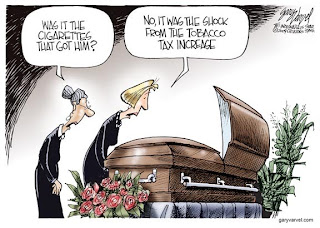
Obama's Cigarette Tax Puts the Lie to His No New Taxes Pledge

By Peter Roff, Thomas Jefferson Street blog

Former Sen. Russell Long, the Louisiana Democrat who for years headed the powerful Senate Finance Committee, used to say that the strategy for increasing federal revenues was grounded in a time-honored D.C. maxim: "Don't tax you. Don't tax me. Tax that fella' behind the tree."

In essence, what Long was talking about was finding ways to tax "someone else," ideally someone who was not in a position to complain about it much or, even better, exact retribution in the voting booth.

As long as "that fella' behind the tree" had money, it worked as a strategy. Unfortunately for a lot of people, it doesn't work anymore. And it can't, because federal borrowing and spending are, as a percentage of Gross Domestic Product, rising too high.

In just a few months President Obama and a Congress controlled by the Democrats have increased non-defense discretionary spending by 8 percent, and then by an additional 10 percent and then by who knows once Congress finishes with the budget. The national debt, says the non-partisan Congressional Budget Office, will double over the next five years. And triple not too much longer after that.

To balance the books, Obama and the Democrats are going to have to find sources for new revenue—which is the polite way to say "Raise taxes."


This effort to find new revenues should be frustrated by what Obama said was his "firm pledge" not to raise taxes on anyone making less than $250,000.00 a year. "Under my plan," Obama said September 12, 2008 in Dover, N.H., "no family making less than $250,000.00 a year will see any form of tax increase." To emphasize the point he continued, "Not your income taxes, not your payroll tax, not your capital gains taxes, not any of your taxes."

He might have well said, "Read my lips." Like a bad April Fools' Day joke, the federal excise tax on cigarettes increased April 1, 2009 by 156 percent (or 61 cents per pack). And this is a tax that everyone who smokes will pay, despite the fact that, according to the taxpayers' lobby Americans for Tax Reform, one in four smokers live below the poverty line and 55 percent of smokers can be defined as "working poor," which means they make something less than $250,000.00 per year.

For all the talk of "repealing the Bush tax cuts" and "increasing the taxes on the wealthiest Americans," there is just not enough money in that economic cohort—even at tax rates that are confiscator—to pay the bills. But no worries. It is now clear that what Obama said, with apologies to the late Sam Goldwyn, wasn't worth the paper it was printed on.


Re-Published Totally without permission (but well worth the re-read) from:
By Peter Roff, Thomas Jefferson Street blog
April 02, 2009 01:25 PM ET Peter Roff Permanent Link Print

FJW Note:

My new non-smoking lifestyle gives me internal conflict over
(1) the unfair and immoral attack on consumers by this kind of
(a) double taxation &
(b) taxation without representation. (And you know that's true!)
And
(2) should I take a who cares attitude because I don't smoke anymore and possibly it will keep young people off cigarettes.
(Maybe push them more to pot since that will remain affordable.)


Reminds me of the Poem by German Pastor Martin Niemoller (1892–1984) referring to the rise of the Nazis in his homeland.

First they came for the communists, and I did not speak out—because I was not a communist;
Then they came for the socialists, and I did not speak out—because I was not a socialist;
Then they came for the trade unionists, and I did not speak out—because I was not a trade unionist;
Then they came for the Jews, and I did not speak out—because I was not a Jew;
Then they came for me—and there was no one left to speak out for me
.

Wednesday, November 4, 2009

Heart attack rates fall 17% after smoking bans enacted

By Liz Szabo, USA TODAY
Blogger's Note: I like repringing articles by Liz Szabo ...
I bet she's HOT!

Community smoking bans have an immediate and dramatic effect on reducing heart attacks, according to two new analyses of laws in the USA, Canada and Europe.

Two separate analyses released Monday each found that heart attack rates fall 17% within a year after smoking bans take effect. One analysis, which included 13 studies, appears in Circulation: Journal of the American Heart Asssociation. A second analysis, which considered 11 studies, appears in the Journal of the American College of Cardiology.

Cigarette smoke can trigger a heart attack in people with underlying heart disease by causing clots or spasms in the blood vessels, says David Goff, a spokesman for the American Heart Association who wasn't involved in either study.

Given that there are about 920,000 heart attacks every year, the studies suggests that public smoking bans could prevent more than 150,000 of these, according to the Cardiology paper.
Taken together, the findings provide strong, consistent evidence that the country should enact more smoke-free laws, Goff says.

"This is a huge, huge effect for a very, very low cost," says Stanton Glantz of the University of California-San Francisco, co-author of the Circulation study.

Smoke-free laws reduce heart attacks in three ways, Glantz says. First, they protect smokers themselves. Second, they protect non-smokers — especially waiters and bartenders — from secondhand smoke. Third, they encourage people to quit or smoke less by making it more difficult for people to find place to light up.

Smoke-free laws have other healthy side effects, says Tom Glynn of the American Cancer Society. They also reduce the risk of lung cancer, although more slowly.
Preventing heart attacks can save money.

Cardiovascular disease costs the country $475.3 billion a year, both in direct costs, such as hospital stays, and indirect costs, such as missed work, Goff says. It costs at least $14,000 to treat one heart attack patient in the hospital, says Goff, who says that cardiac rehab, medication and other care cost even more.

"Really pushing strong smoke-free policies has a huge effect on health care costs by simply avoiding disease," Glantz says.

Thirty-one states now forbid smoking in workplaces, restaurants or bars, according to the American Nonsmokers' Rights Foundation. About one in five adults smoke, according to the Centers for Disease Control and Prevention.

Monday, November 2, 2009

~ A 'Teachable' Moment ~

If you still need incentives to quit smoking or in some of our cases to stay quit, you could try cancer screening. Knowing that smoking significantly increases your risk for head, neck, and lung cancer may not be incentive enough to make you stop smoking or keep you from picking one up after having quit for any period of time. Discovering that secondhand smoke is freakishly unhealthy for your children, partner, pets or the people in riding in your car may not be the most powerful incentive either. If you're really ready to kick the habit or still fighting urges after quitting, you may want to try something new.
Lung cancer screening
The Mayo Clinic found that lung cancer screening helps some people stop smoking and can be added encouragement for others to never pick up another cigarette. Dr Matthew Clark says, "Our results indicate that people who participate in cancer screening were motivated to quit smoking. Cancer screening may present a 'teachable moment'." (And who couldn’t use more of those??) That is, when people learn how their lungs function and how smoking affects their organs, they may be more motivated to stop or stay stopped smoking.
If patients receive abnormal lung cancer screening results, they're (not surprisingly) even more motivated to quit. The more abnormal lung screenings they receive, the easier it is to quit. Lung cancer is the most preventable cancer; smoking causes 85% of lung cancer diseases.

Saturday, October 31, 2009

HAPPY HALLOWEEN!

It's October 31, 2009 --
What does that mean??

For me it means:
Seventeen (17) weeks ...
119 days ... and a few days short of
Four months with out a smoke!
Not even one puff! Woo~hoo!

Editor's Note:
CONGRATULATIONS KEVIN~
It's kind of been like we share a Birthday just a few days apart!
Very cool --
It seems like most of our fellow recovering smokers have dropped out but hopefully we can pick up and encourage a few new ones.

If anyone's been reading this blog for awhile you know this isn't my first attempt at quitting. After so many attempts, I can only remember my longest was nearly one year; I can't be sure of my second longest but right now I am sure if I haven't surpassed it yet I'm closing in on it now.

Additionally, if you've been reading along you may be aware I am not an Anti-Smoker -- I am simply someone who's been addicted to nicotine and smoking for nearly 30 years with little to no success at Kicking The Habit.

All I want to do is use this blog to fight my own demons regarding this addiction as well as give tools, encouragement and hope to others to combat theirs!

Happy Halloween Everybody! FJW

PSS: Reminder -- End of Daylight Savings Time --
After you are done drinking and not smoking tonight,
Don't for get to FALL BACK!

And Now for Something REALLY Scary ~


Thursday, October 29, 2009

Weighing up the Pros and Cons of Smoking in your mind~

Dr Seuss sums up nice and simply what to do...
You have brains in your head
You have feet in your shoes
You can steer yourself
Any direction you choose
And you're on your way
And you know what you know
And YOU are the guy (or gal) who'll decide where to go.

If you're still a smoker, are you tossing around the personal pros and cons of smoking or quitting that might affect you?
Do you think it's time to quit?
Got conflicting thoughts?
You may think you need to quit. All smokers need to quit, but do you want to quit?
You may work in a pro smoking environment, or have smoking friends wanting to keep you addicted, making it harder for you to decide.

So if you're turning over the pros and cons of smoking in your mind, it will help you to know that there are 5 recognized stages of change that most people go through before they take a leap, whether it be to stop an addiction, change career, move house and so on.

These 5 stages are:
Denial or avoidance of challenge or problem, in fact often actively promoting it and trying to convert others to it.
Pre-contemplation. A little voice in the back of their mind and the beginnings of seeking a change.
Investigation, shift in mental awareness, desire to change and efforts and plans made to find solution, a decision made and action taken.
Going through the change.
Maintenance.
Depending on method used, either putting problem behind them, or having to maintain control of previous problem, short term or long term, to stop it surfacing again.

If it's decision time for you, read as much free information as you like on this website, then put those bothersome pros and cons of smoking behind you and check your Desire.
Is your desire for what you want strong and sure? Are you clear in your mind that it is your decision, not anybody else's, to stop smoking, and you have decided you want to do this enough so that you will do the necessary actions to complete this to the end?

Understand this - you don't have to be 100% committed yet. That will come as you draw confidence from your initial successes, but you must be at least clear that you want to stop smoking, and are ready and willing to put your best foot forward.

Put your best foot forward and keep reading this blog for all the resources you need and PLEASE fell free to suggest more!